
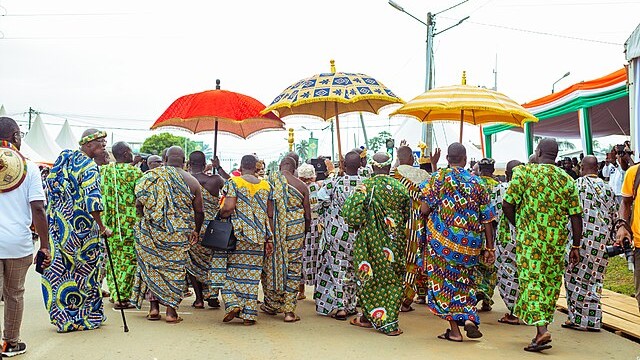
In Côte d’Ivoire, the rhythms of daily life are set against a mosaic of more than sixty ethnic groups, each with its own history, language, and traditions. From the bustling streets of Abidjan to the cocoa-growing villages of the west, traces of these communities are found in festivals, markets, and music that give the nation its distinct cultural texture.
The Akan, Krou, Mandé, and countless others each bring their own customs—be it the intricate weaving of kente cloth, the polyphonic chants of village ceremonies, or the syncopated beats of the djembé. In the urban nightclubs, the buoyant steps of the modern Zouglou dance echo age-old patterns, blending ancestral memory with contemporary expression.
This variety has not fractured the nation’s sense of identity; instead, it has fostered a culture of exchange. Shared spaces—whether market squares, fishing docks, or festival grounds—become meeting points where different traditions intermingle. It is common for celebrations to incorporate influences from several ethnic groups, a visual and sonic testament to mutual respect.
Language acts as both a marker of heritage and a bridge across differences. While French serves as the official tongue, many Ivorians move easily between indigenous languages, regional dialects, and even Pidgin English, creating a fluid linguistic landscape. In marketplaces, greetings are exchanged in one language and bargaining conducted in another, a practical multilingualism that reinforces social ties.
This ethos of unity has been tested in the country’s modern history, particularly during periods of political and social tension. Yet community leaders and cultural figures have consistently worked to restore dialogue, drawing on shared traditions as a foundation for reconciliation. Drumming circles, harvest festivals, and storytelling gatherings have often played as much a role in healing as formal negotiations.
Today, the strength of Côte d’Ivoire’s identity lies in its ability to hold many histories at once. The country’s cultural fabric is not a patchwork stitched in haste, but a weaving centuries in the making—its threads strengthened by contact, exchange, and resilience. In this tapestry, each pattern tells a story, and together they form a portrait of a nation bound by its differences as much as its common ground.
Sources:
- UNESCO, Intangible Cultural Heritage of Côte d’Ivoire, 2023.
- Ministère de la Culture et de la Francophonie de Côte d’Ivoire, Diversité Culturelle et Unité Nationale, 2022.
- BBC Africa, How Music and Language Unite Côte d’Ivoire, 2021.