
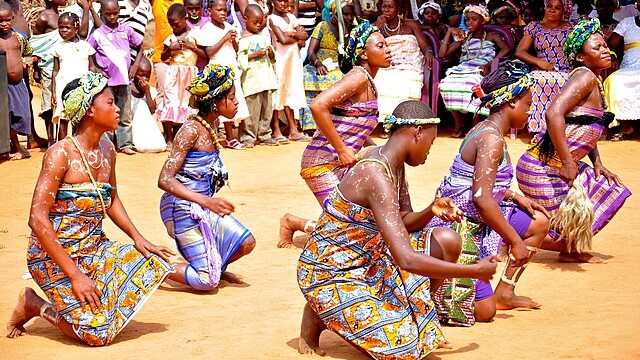
In Ghana, movement is memory. From the streets of Accra to the northern savannas, dance is both spectacle and statement, a way of preserving history while shaping the present. Across regions, distinct rhythms and gestures tell stories of ancestry, labor, faith, and joy. What emerges is a cultural landscape in which dance is not a pastime but a language—spoken through the body, passed through generations.
In the Greater Accra Region, Azonto has become emblematic of the city’s modern energy. Born in coastal fishing communities, the dance spread rapidly through schools, nightclubs, and eventually the global stage. Its syncopated footwork and playful hand gestures often mirror daily life—mimicking work, flirtation, or humor—while offering a glimpse into the improvisational spirit of urban Ghana.
The Western Region offers another rhythm altogether. Here, Adowa is performed by the Akan, particularly the Akuapem, during funerals and festive occasions. Its movements are understated yet layered with symbolism: hands rise and fall in gestures that evoke dialogue with ancestors, while drumming underscores the gravity of life’s transitions. The dance functions as both lament and celebration, reflecting the community’s ability to honor loss while affirming continuity.
Farther north, the Ngmayem festival of the Krobo people places dance within the cycle of agriculture. Movements echo the sowing and harvesting of crops, embodying gratitude for the land and its yield. Costumes are vibrant, with beads and cloth signaling lineage and identity, turning the performance into a living tableau of cultural heritage. For the Dagombas of the Northern Region, similar traditions tie dance to oral history, linking storytelling to rhythm in ways that reinforce memory and belonging.
In the Central Region, the Gahu dance radiates exuberance. Typically performed at gatherings, it blends intricate drumming with choreography that invites collective participation. Its tone is less solemn than Adowa, more communal than Azonto, embodying joy as a binding force. Performances often spill from formal stages into open-air celebrations, collapsing the distinction between performer and audience.
Kpanlogo, also rooted in Greater Accra, reflects Ghana’s post-independence spirit. Developed in the 1960s among the Ga youth, it fused traditional rhythms with influences from highlife music. Today, it remains a fixture at festivals and rallies, its energetic beats and movements emblematic of cultural adaptation in an era of rapid change.
Together, these dances form a mosaic of Ghanaian life. They are records of migration and resilience, reflections of faith and mortality, and celebrations of community. To witness them is to see a society conversing with itself, past and present entwined. In an age of digital music and shifting cultural borders, the vitality of Ghana’s dance traditions testifies to their enduring relevance. The rhythm continues, unbroken.
Sources:
- Collins, John. Highlife Time. Anansesem Publications, 1996.
- Nketia, J.H. Kwabena. The Music of Africa. W.W. Norton & Company, 1974.
- Ghana Dance Ensemble, University of Ghana, official archives.