
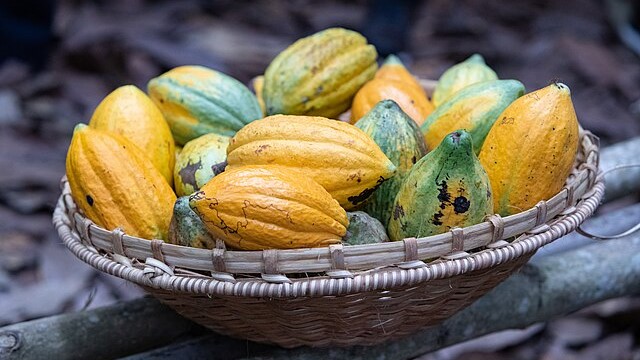
In the humid lowlands of Côte d’Ivoire, where morning mists hang over fields of emerald foliage, cocoa pods swell in shades of yellow, orange, and deep crimson. Here, in the world’s largest producer of cocoa beans, the global story of chocolate begins—not in the gleaming factories of Europe or North America, but in smallholder farms where cultivation is a way of life.
The landscape is a study in abundance. Rolling hills give way to dense groves where the cacao trees thrive under a canopy of taller shade plants. Their gnarled trunks and glossy leaves conceal the heavy pods that, once split, reveal the bitter seeds destined for transformation. This tropical terrain, shaped by equatorial rains and rich soils, provides the ideal conditions for a crop that has defined both the economy and the cultural identity of the nation.
Farming here is more than an occupation; it is a legacy. Many producers trace their knowledge through generations, their techniques honed over decades. The cycle begins slowly—cocoa trees yield their first pods only after three or four years—yet once mature, a healthy tree can produce thousands of pods annually. Harvesting is meticulous work: farmers use short-handled blades to cut the pods by hand, avoiding damage to the tree.
After harvest, the beans and pulp are heaped into wooden boxes or banana-leaf mounds for fermentation, a process lasting several days that deepens their flavor. Spread out on wide mats beneath the sun, the beans are turned regularly until fully dried. It is labor-intensive work, done under heat and humidity, yet it is here that the essence of fine chocolate begins to take shape.
Beyond the farms, the cocoa trade connects to bustling markets and port cities. In Abidjan’s open-air stalls, the scent of roasting beans mingles with that of smoked fish and spices. The country’s more than sixty ethnic groups converge in these spaces, exchanging goods, stories, and traditions that extend far beyond agriculture. Cocoa is a unifying thread, linking rural producers to urban traders and, ultimately, to international buyers.
The impact of Côte d’Ivoire’s cocoa extends far beyond its borders. Beans from these fields find their way into the production lines of some of the world’s most recognizable chocolate brands. Each bar that reaches store shelves carries with it the imprint of the land and the labor of those who tend it. For farmers, the global appetite for chocolate offers both opportunity and challenge—balancing market demands with the push for fair trade and sustainable practices.
In recent years, cooperative initiatives have sought to improve conditions for growers, focusing on environmental stewardship, community development, and equitable pricing. These efforts, while still evolving, reflect a recognition that the future of chocolate depends on the health of the soil, the welfare of the farmers, and the preservation of the traditions that sustain them.
The story of cocoa in Côte d’Ivoire is thus not only an agricultural narrative but also one of cultural continuity, economic interdependence, and resilience. It is a reminder that every sweet bite has its roots in a place where the work is measured not in confections, but in seasons, harvests, and the patient tending of a tree.
Sources:
- International Cocoa Organization (ICCO), Cocoa Year in Review, 2023.
- United Nations Food and Agriculture Organization (FAO), Cocoa Production in West Africa, 2022.
- Fairtrade International, Cocoa and Sustainability Report, 2023.
- Ministère de l’Agriculture et du Développement Rural de Côte d’Ivoire, Plan Stratégique du Cacao, 2022.