
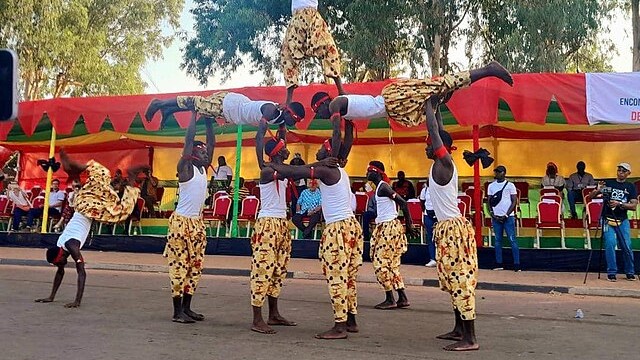
In Guinea-Bissau, the rhythms of life are marked by celebration. Festivals here are not fleeting diversions but deeply rooted gatherings that reveal the character of a small West African nation often overlooked on the global stage. They speak of ancestry, belief, and the enduring force of community, blending spectacle with quiet rituals that bind generations.
Each year, the calendar unfolds in bursts of sound and color. The Bissau Carnival, typically staged in late February or early March, transforms the capital into a living mural. Parades surge through the streets as dancers in elaborate costumes sway to the beat of drums and brass. The event, often compared to carnivals in Brazil or Cape Verde, is less commercial in scale but no less fervent in spirit, carrying a strong sense of collective pride.
Further north, the Djogos festival conveys a different energy. Rooted in ancestral devotion, the gathering honors spirits believed to guide and protect communities. Music and dance performances weave together stories carried across centuries, their choreography often recounting mythic origins and hard-won survival. The festival underscores the continuity of tradition, where spirituality is inseparable from daily life.
Not all commemorations are centered solely on cultural expression. In November, Guinea-Bissau marks the International Day for the Elimination of Violence Against Women with public demonstrations, workshops, and performances. These events highlight pressing social issues while extending the idea of festival into the realm of civic responsibility. They serve as reminders that celebration, in this context, also carries the weight of aspiration and protest.
On the Bijagos Islands, the Tabanka Festival takes on a maritime tone, celebrating the deities tied to the sea and the archipelago’s storied fishing traditions. Rituals unfold on sandy clearings where villagers gather in rhythmic unison, accompanied by pounding drums, improvised chants, and communal feasts of fish and rice. For the islanders, Tabanka is less a performance than a reaffirmation of belonging—to the sea, to each other, and to their gods.
Across the country, these festivals serve as both mirrors and bridges: mirrors reflecting centuries-old practices, and bridges connecting generations through music, dance, food, and shared storytelling. In their diversity, they offer an intimate portrait of a nation that continues to draw strength from the collective, even amid modern challenges.
Sources
-
Forrest, Joshua B. Guinea-Bissau: Power, Conflict, and Renewal in a West African Nation. Westview Press, 1992.
-
Lopes, Carlos Cardoso. “Culture and Identity in Guinea-Bissau.” Africa Today, vol. 38, no. 2, 1991, pp. 33–45.
-
United Nations. “International Day for the Elimination of Violence against Women.” UN Women, 2023.
-
Mendy, Peter Karibe. Historical Dictionary of the Republic of Guinea-Bissau. Scarecrow Press, 1996.