
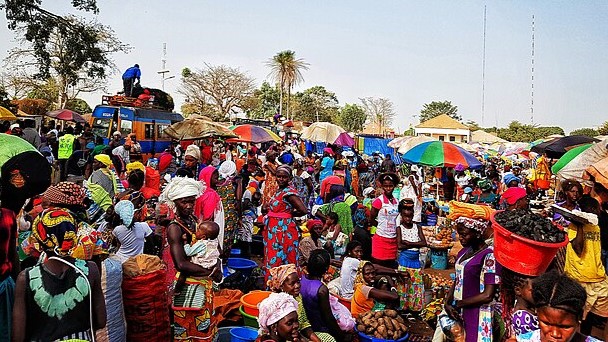
In the Guinean capital of Conakry, markets are more than centers of commerce; they function as the city’s pulse, shaping its rhythms through trade, tradition, and daily interaction. To walk among the stalls is to glimpse the country’s identity in its most tangible form—its foods, its crafts, and its community spirit, each woven into the bustle of everyday life.
The Marché Madina, sprawling and crowded, is the city’s largest market and one of West Africa’s most dynamic. Vendors call out to passersby as rows of stalls spill over with bananas, yams, okra, and cassava. Bright heaps of mangoes and papayas sit alongside bundles of leafy greens, illustrating agricultural practices that have long sustained Guinea’s interior regions. Here, trade is not only a matter of necessity but also a living expression of ties between rural producers and urban families.
Further inside, aromas shift from earthy produce to the sharp, warm scent of spices. Cardamom, ginger, cloves, and chili are sold in neat piles or scooped into paper cones. These ingredients form the backbone of Guinean cuisine, a culinary tradition defined by depth of flavor and a reliance on slow cooking. Poulet yassa, a chicken dish steeped in onions and lemon, or kedjenou, a stew rich with peppers, often begin with spices purchased in markets like these. Recipes are carried from one generation to the next, with vendors themselves sometimes serving as informal custodians of culinary memory.
Beyond food, the markets double as galleries of craftsmanship. Textiles dyed in vibrant batik patterns hang in folds from wooden frames, while handwoven baskets and carved wooden utensils occupy nearby stalls. Each piece reflects regional traditions of design and labor, its value extending beyond utility to the preservation of cultural artistry. In this sense, a market purchase often carries a heritage as well as a function.
The soundscape of the markets is as distinctive as their wares. Laughter spills from groups of children darting through narrow aisles, while the banter of bargaining punctuates the hum of commerce. Occasionally, rhythms from hand drums or radios mix into the din, lending a musical quality to the trading floor. For residents, these sounds form part of the city’s daily soundtrack; for visitors, they highlight the vibrancy of Conakry’s social fabric.
These markets also mirror the challenges facing Guinea’s economy. Informal vendors contend with fluctuating prices, limited infrastructure, and the pressures of globalization, yet their resilience underscores the enduring role of local exchange in the nation’s life. Amid the chaos, the warmth of community remains evident—in gestures of hospitality, in shared meals, in the willingness of sellers to pause and explain the origins of their goods.
Conakry’s markets, in their noise and color, distill the essence of a capital that is at once modern and traditional. They stand as living archives of a culture rooted in the land, continually reshaped by the demands of contemporary life yet anchored in memory and practice. To understand Guinea through its capital is, in many ways, to begin with these marketplaces—where food, craft, and community meet.
Selected Sources
- International Trade Centre. The Market Environment in West Africa: Case Studies from Guinea. ITC Report, 2019.
- Lamp, Frederick. Art of the Baga: A Drama of Cultural Reinvention. Smithsonian Institution Press, 1996.
- United Nations Development Programme (UNDP). Sustainable Livelihoods and Market Systems in Guinea. UNDP Regional Report, 2020.
- Bah, Alpha Oumar. Conakry et son Urbanisme Marchand. Karthala, 2014.