
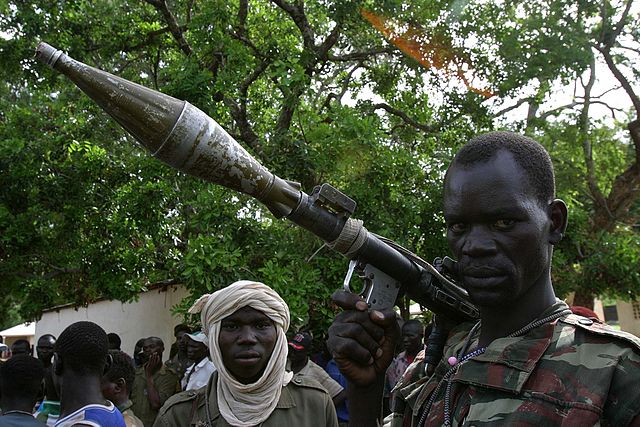
KAGA-BANDORO, Central African Republic — The morning air in this northern market town carried a deceptive stillness. Beneath tin awnings, traders arranged cassava roots and bruised tomatoes in neat piles. A few stalls away, children, bare-footed and quick with laughter, chased a sagging soccer ball through a swirl of red dust.
The calm broke with the first crack of gunfire. It lasted less than ten minutes. When the sound faded, the fighters had already melted into the bush, leaving jittery soldiers and another day’s losses for the community to absorb.
It is a familiar rhythm here: a war without front lines, where ceasefires dissolve in the heat of midday and no one pretends to count the number of broken truces. In the Central African Republic, ten years of conflict have produced no victor, only survivors.
A Fragmented Battlefield
The rupture began in 2013, when the predominantly Muslim Seleka coalition seized power from President François Bozizé. Their advance ignited violent reprisals from largely Christian militias calling themselves anti-Balaka, plunging the country into one of Africa’s most intricate and enduring conflicts.
Since then, the map has splintered into a shifting mosaic of militias, self-defense groups, and opportunistic alliances. A recent UN Security Council report estimates that more than a dozen armed factions still operate, many reborn under new names but carrying old grievances — and the same weapons.
The 2019 Khartoum Agreement, negotiated under the African Union with Russian backing, sought to dismantle these networks. Yet most militias have resisted full disarmament, keeping their territorial strongholds intact. Peace here is less a settlement than a series of local arrangements, enforced by negotiation, intimidation, and the quiet knowledge of who controls which stretch of road.
The Capital’s Reach, and Its Limits
Officially, President Faustin-Archange Touadéra’s government holds authority over the nation. In practice, its presence rarely extends beyond key towns, leaving vast tracts under the sway of non-state actors.
“The government has neither the reach nor the resources to assert control in most provinces,” said Nathalie Dukanda of the International Crisis Group. “So it negotiates with warlords and calls it peace.”
The fragility was laid bare in late 2020, when the Coalition of Patriots for Change — an alliance of rebel factions — launched a campaign to derail national elections. The bid failed to capture Bangui but prompted the deployment of Russian paramilitary units linked to the Wagner Group.
Human Rights Watch investigations in 2023 recorded abuses by both state forces and foreign mercenaries, ranging from arbitrary detentions to extrajudicial killings. The United Nations has cautioned that such tactics risk entrenching, not resolving, the conflict.
Civilians in the Crossfire
For those in rural provinces, distinctions between soldier and rebel blur easily. “They all have guns. They all take what they want,” said a pastor from Mbomou, speaking on condition of anonymity for security reasons.
According to the UN Office for the Coordination of Humanitarian Affairs, more than half a million people remain displaced within the country, with a further 700,000 living as refugees abroad. In rebel-held zones, schools are often shuttered, roads littered with illegal checkpoints, and aid convoys slowed by harassment from all sides.
“This is not a frozen conflict,” said Jean-Paul Mbemba, a field coordinator for Médecins Sans Frontières. “It is simmering. Always.”
Local Pacts, Fragile Gains
Some progress emerges in pockets, where community mediators, religious figures, or non-governmental groups broker limited ceasefires. In certain areas, these agreements have reopened clinics or allowed seasonal markets to resume.
But the gains are precarious. Without comprehensive disarmament and genuine decentralization, analysts warn, the current model — a militarized peace reliant on external forces — will remain brittle.
“Eventually, a fragile peace maintained at gunpoint breaks,” Dukanda said. “The only question is when.”
Sources:
- United Nations Security Council, “Report of the Secretary-General on the Situation in the Central African Republic,” 2024.
- Human Rights Watch, Central African Republic: Abuses by Armed Groups and Security Forces, 2023.
- Médecins Sans Frontières, “CAR: Humanitarian Situation Overview,” 2024.
- International Crisis Group, Central African Republic: Stalled Peace Process, 2023.