
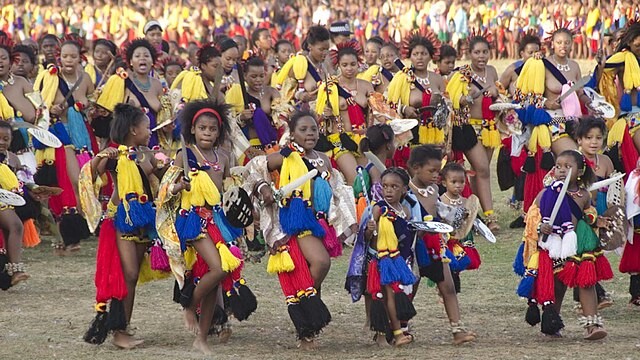
In Eswatini, the rhythm of drums and the swirl of color mark the passage of time. Festivals here are more than seasonal celebrations; they are expressions of history, continuity, and collective identity in one of Africa’s last remaining monarchies. This small Southern African kingdom, landlocked between South Africa and Mozambique, has preserved a vibrant calendar of cultural gatherings that bring together ritual, music, dance, and community life.
The most renowned of these events is the Umhlanga, or Reed Dance, held annually between late August and early September. Thousands of young women, dressed in traditional attire, converge from across the kingdom to cut reeds, which they present to the Queen Mother. The ceremony is at once ceremonial and social: a performance of song and dance, but also an affirmation of cultural values tied to respect, unity, and the central role of women in Swazi society. Brightly beaded costumes and rhythmic chants fill the royal grounds, transforming them into a stage where tradition and spectacle intertwine.
Equally significant is the Incwala, or First Fruits Ceremony, celebrated in December and January. Rooted in the agricultural cycle, the festival marks the harvest and honors both the king and ancestral spirits. Over several days, rituals unfold with symbolic precision—songs, dances, and the tasting of the first harvest’s produce. The Incwala binds the nation together in gratitude, placing the monarchy at the heart of communal renewal.
Eswatini’s cultural calendar, however, is not defined by tradition alone. The Swazi Jazz Festival, an increasingly popular event, blends contemporary music with heritage. Local and international artists share the stage, and the rhythms range from modern jazz to fusions of indigenous Swazi sounds. For many, the festival underscores how music functions as both storytelling and celebration, bridging generational and cultural divides.
Markets and craft fairs, scattered throughout the year, add yet another dimension to the cultural landscape. These gatherings showcase the work of artisans who weave textiles, carve wood, and shape jewelry, often drawing on motifs passed down through families. Such markets serve as spaces where heritage is sustained in tangible form, and where craft is inseparable from livelihood.
Taken together, Eswatini’s festivals reveal a kingdom where culture remains a living force. They embody more than performance or ritual; they are communal expressions of resilience, pride, and continuity. In the drumbeats of the Reed Dance, the solemn chants of the Incwala, or the improvisations of a jazz ensemble, the story of Eswatini’s heritage is retold—alive in motion, sound, and shared experience.
Sources:
- Eswatini Tourism Authority. Festivals and Cultural Heritage in the Kingdom of Eswatini. Mbabane, 2023.
- Booth, Alan. Historical Dictionary of Eswatini (Swaziland). Scarecrow Press, 2000.
- Dlamini, Hlengiwe. “Ceremonial Life and Identity in Contemporary Eswatini.” Journal of African Cultural Studies, vol. 34, no. 2, 2022.
- Murdoch, Jason. “From Ritual to Performance: The Reed Dance and National Identity in Eswatini.” African Affairs, vol. 120, no. 479, 2021.