
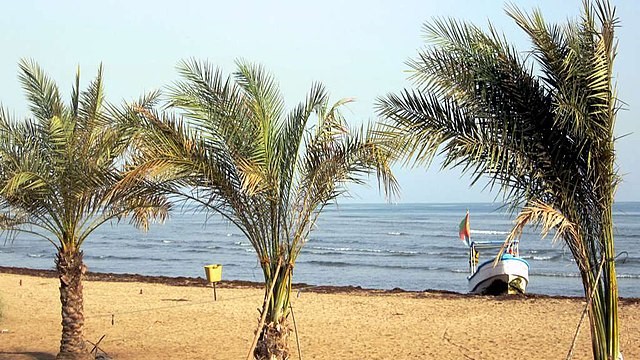
Stretching for more than a thousand kilometers, Eritrea’s Red Sea coastline is a landscape of striking contrasts—where coral reefs glimmer beneath turquoise waters and centuries-old port towns rise from the shore in sun-bleached stone. Both culturally layered and naturally rich, the coastline has long been a crossroads of trade, migration, and tradition, though today it remains one of the least-explored stretches of the Red Sea.
The journey often begins inland, in Asmara, the capital. The city is celebrated for its art deco architecture, built during the Italian colonial period, and for the rhythm of its daily life—markets alive with color, cafés serving strong macchiatos, and street corners filled with the sound of conversation. From here, travelers descend toward the coast, sometimes by ferry or winding mountain roads, passing landscapes that shift from cool plateaus to the intense heat of the lowlands.
Massawa, an ancient port city along the coast, offers the most direct encounter with Eritrea’s layered history. Its architecture, a blend of Ottoman, Egyptian, and Italian influences, tells the story of a city that has been both a prize and a crossroads for centuries. Along the waterfront, coral-stone buildings, mosques, and arched arcades stand as reminders of its role as a hub of Red Sea commerce. Seafood is central here—grilled fish fresh from the market stalls, or zgni, a richly spiced stew, appear on many tables. Pasta dishes, a legacy of colonial influence, remain an unexpected but beloved staple.
Farther out to sea lies the Dahlak Archipelago, a scattering of more than 350 islands, many of them uninhabited. These islands are renowned among divers for their clarity of water and diversity of marine life. Coral reefs teem with schools of brightly colored fish, sea turtles graze in seagrass beds, and pods of dolphins break the surface of calm waters. In deeper channels, the shadow of a whale shark is not an uncommon sight. Snorkelers find ample rewards in the shallows, where the underwater world reveals itself in layers of color and movement.
Beyond diving and exploration, the islands offer quietude. Beaches stretch out with scarcely a footprint, their sands warmed by an unrelenting sun. At dusk, skies shift through shades of amber and rose, casting long reflections across the water and lending the coastline an almost otherworldly calm. For many, this tranquility defines the experience as much as the wildlife or history.
The Red Sea coast of Eritrea remains a place of paradox: shaped by centuries of human movement yet still marked by an unspoiled quality rare in much of the modern world. It is at once a historic crossroads and a largely untouched wilderness, a landscape that speaks as much through silence and space as through its bustling ports and enduring traditions. For those who encounter it, the impression often lingers long after departure—a memory of beauty both natural and cultural, bound tightly to a sense of place.
Sources:
- Tekeste Negash, Eritrea: The Cultural Landscape, Nordiska Afrikainstitutet, 2011.
- Ruth Iyob, The Eritrean Struggle for Independence, Cambridge University Press, 1997.
- United Nations Environment Programme (UNEP), “Coastal and Marine Biodiversity in Eritrea,” 2020.
- BBC Travel, “Exploring Eritrea’s Red Sea Coastline,” 2021.